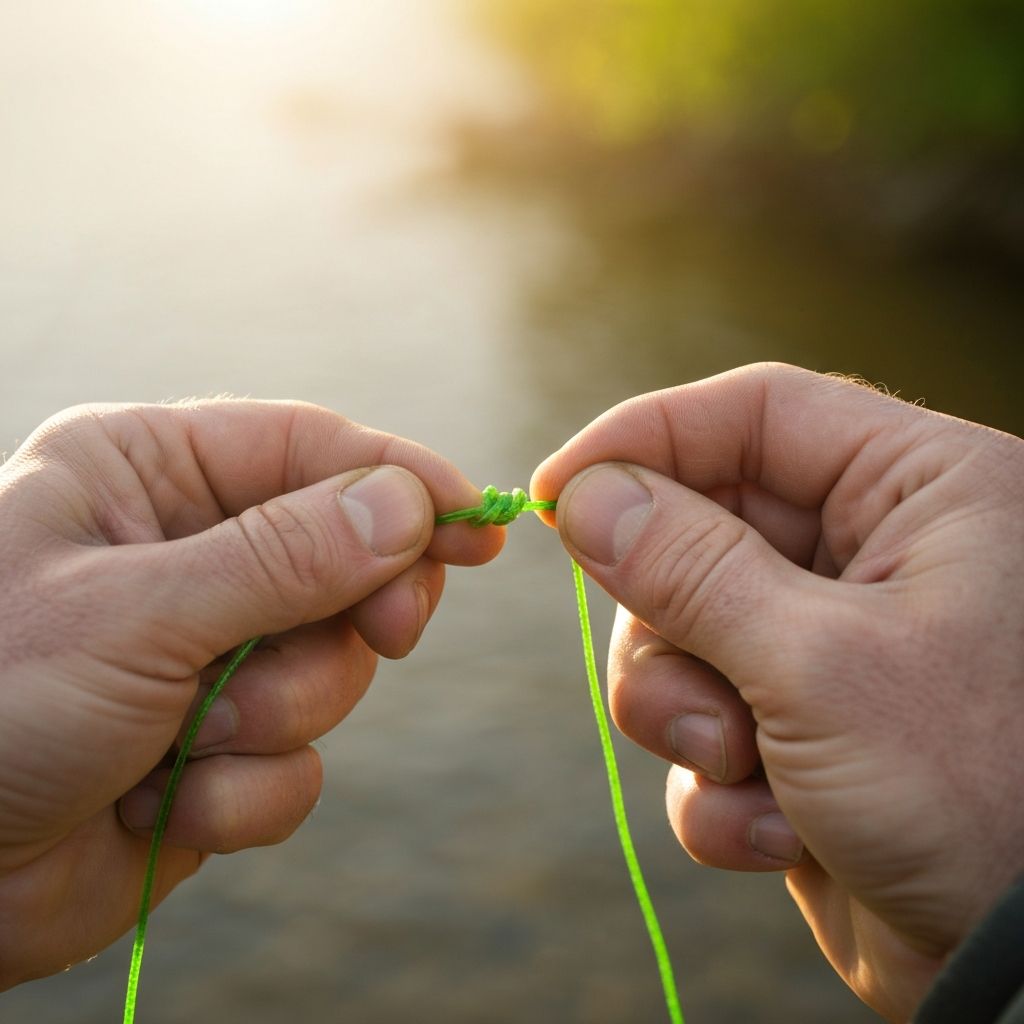
Why Knots Matter
The weakest point in any fishing setup is the knot. A correctly tied knot in quality monofilament retains 90–95% of the line's stated breaking strain. A poorly tied or incorrect knot can reduce this to 50% or less - meaning you are fishing with half the strength you think you have. On Hungarian waters where large carp, catfish and pike are realistic targets, a failed knot at the critical moment is a painful experience.
1. The Palomar Knot
The Palomar is arguably the strongest and most reliable all-round fishing knot, and it is fast to tie. Double 15cm of line and pass the loop through the hook eye. Tie a simple overhand knot with the doubled line, leaving a large loop hanging. Pass the loop over the hook. Wet the knot and pull tight. The Palomar tests to above 95% line strength consistently and works equally well with monofilament, fluorocarbon and braid.
2. The Improved Clinch Knot
One of the most widely used knots in freshwater fishing. Thread the line through the hook eye, double back and make 5–7 wraps around the main line. Pass the tag end back through the small loop directly above the eye, then through the large loop just created. Wet and pull tight. The improved clinch is reliable, quick to tie, and ideal for attaching hooks and swivels to monofilament hooklinks up to 15 lb.
3. The Grinner Knot (Uni Knot)
The Grinner is the preferred knot for attaching hooks and swivels to heavier monofilament. Thread the line through the eye, fold it back parallel with the main line, and form a loop. Make 5–6 turns of the tag end around both strands inside the loop. Pull the tag end to tighten the coils, then slide the completed knot down to the eye. The Grinner maintains strength in heavy mono where clinch knots can slip.
4. The Blood Knot
For joining two lines of similar diameter - connecting a hooklink to a main line, or joining two sections of monofilament. Overlap the two lines for 10cm. Wrap one tag end around the other line 5 times and pass it back through the central gap. Repeat with the other tag end in the opposite direction. Wet thoroughly and pull both main lines simultaneously until the coils slide together. Trim tags.
5. The Loop-to-Loop Connection
The quickest method for connecting and changing hooklinks, particularly when feeder fishing or carp fishing with pre-tied rigs. Form a small overhand loop at the end of your main line using a loop knot. Form an identical loop at the end of your hooklink. Pass the hooklink loop through the main line loop, then pass the hook end of the hooklink through the hooklink loop and pull tight. This creates a fast, reliable connection that can be changed in seconds.
6. The Half-Blood Knot for Braid
Standard knots often slip on braid because the surface is too smooth. For connecting braid to swivels, double the braid and thread both strands through the eye. Make 5–6 turns of both strands around the main braid, pass the doubled end back through the first loop, then through the large loop. Wet with saliva and pull very slowly until the knot beds down. Never jerk a braid knot tight - it will slip.
Practise Before You Fish
- Tie each knot at home on spare line until the muscle memory is there - fumbling with a knot in the dark or cold is when mistakes happen.
- Always wet the knot before pulling tight - friction heat weakens line significantly.
- Cut the tag end close but leave 1–2mm - knots can draw under load and a tiny tag prevents slippage.
- Test every knot with a firm steady pull before you cast out.